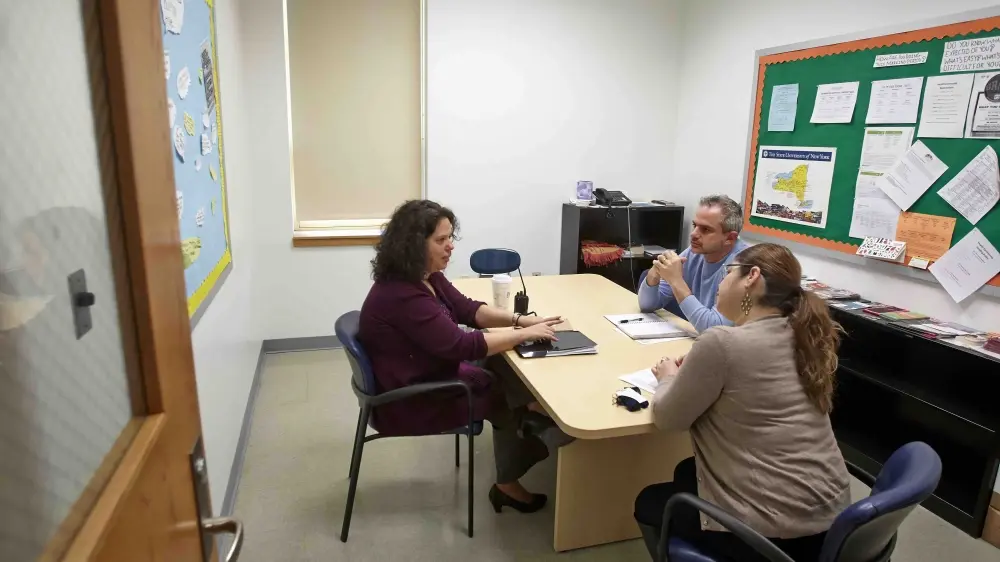
Researchers from NYU Steinhardt conducted a two-part study of NYC schools, including those specifically serving English learners, to analyze which factors contributed to student success in earning high school credits.
What factors help English learners (ELs) succeed in schools? In a study of top performing New York City high schools serving immigrant ELs, researchers linked three conditions—teacher autonomy, collaboration, and collective responsibility—to higher credit attainment.
“Most research on ELs focuses on classroom instruction or broader language policies, but our study describes the professional conditions that positively impact outcomes for immigrant ELs,” says Adriana Villavicencio, lead author and assistant professor of educational leadership and policy studies at NYU Steinhardt. “We took this approach to address a dearth of evidence of the practices and approaches that have been long documented by scholars.”
Villavicencio and her co-authors conducted a two-part study published in American Educational Research Journal. First, to understand what factors shape student outcomes, they studied two New York schools within the Internationals Network for Public Schools, a network of schools whose ninth-grade students have been in the US for four years or fewer. The schools were selected for having the most positive gains in credits earned/credits attempted.

This work suggests that rather than focus primarily on language acquisition, schools should focus on supporting the work of teachers and creating the conditions for collaboration.
From 2018 to 2020, they collected data from documents, classroom and meeting observations, interviews, and focus groups. After analyzing themes related to school culture, professional practices, and curriculum, they identified three critical conditions for student success:
- Teacher influence/autonomy—freedom to make decisions regarding curricula and professional development, allowing for cultural and linguistic learning opportunities
- Peer collaboration—deep levels of teacher collaboration across disciplines and grade levels
- Collective responsibility—a shared vision and advocacy for immigrant students
For the second part of the study, they used data from the 2012 New York City Learning Environment Survey (a large-scale survey in which education leaders, teachers, and parents answer questions related to curriculum, culture, and climate) and NYC administrative data on student credits, to determine whether there were any links between these practices and student outcomes. They evaluated NYC schools broadly, including those that specifically serve ELs.
They found that all three factors were positively associated with academic achievement for all students, but that the relationships were even stronger in schools with a greater proportion of ELs, meaning that they benefited the most.

These findings help confirm previous research on the efficacy of the Internationals Network in taking a holistic approach to serving immigrant ELs.
This finding was the strongest in schools with the highest levels of teacher collaboration. For schools with an average proportion of ELs, those with the lowest and highest levels of peer collaboration among teachers had a 10-point difference in their ratio of credits attempted vs. attained by students. In schools with the highest proportion of ELs, this difference was more than double (23 points). Similar results were found for teacher influence/autonomy and collective responsibility.
“This work suggests that rather than focus primarily on language acquisition, schools should focus on supporting the work of teachers and creating the conditions for collaboration, while cultivating a school-wide commitment to the academic and socioemotional outcomes of their students,” says Villavicencio.
“These findings help confirm previous research on the efficacy of the Internationals Network in taking a holistic approach to serving immigrant ELs,” says co-author Hua-Yu Sebastian Cherng, vice dean for research and equity and professor of international education at Steinhardt. “This approach is also beneficial for ELs in various settings, which can help inform schools beyond the Network, and perhaps even outside New York City.”
Villavicencio and Cherng are members of the research advisory board of the Internationals Network for Public Schools.
This study was co-authored by Reva Jaffe-Walter, an associate professor at Montclair State University.
This study was funded by the W.T. Grant Foundation.
Press Contact
(646) 469-8496

Adriana Villavicencio
Associate Professor of Educational Leadership and Policy Studies

Related Articles

Studies of English Learners Grouped Together Show Negative Outcomes or No Benefit

Study Finds That White Students Visit College Advisors the Least, but Benefit Most in Terms of Graduation Rates and GPA