
Madelyn Escario (MS ’25) is the initial author of research that will appear in the Journal of Speech, Language, and Hearing Research.
An article based on a master’s thesis written by Madelyn Escario (MS ’25, Communicative Sciences and Disorders) has been accepted for publication in the Journal of Speech, Language, and Hearing Research. “The Role of Word Order in Toddlers’ Acquisition of Novel Adjectives” details an experimental study that examined how sentence structure can help toddlers better learn new descriptive words.
For her research, Escario worked with Sudha Arunachalam, vice dean for research and professor of Communicative Sciences and Disorders (CSD) at NYU Steinhardt, as well as Marielle Ngoma, an undergraduate intern in Arunachalam’s lab. The two-year research project examined whether children learn unfamiliar adjectives more effectively when they appear before a noun—such as “this is an XYZ cup”—or after it, as in “this cup is very XYZ.”
The study examined adjective learning by using familiar concepts such as colors (“blue/yellow”), size (“big/small”), and shape (“tall/short”), but assigning them nonsense labels such as “fip.”
The results of the study showed that toddlers learn novel adjectives better when they appear before a noun, or “prenominally,” as opposed to after it. This indicates that when a child hears a new adjective for the first time, a prenominal construction may be more supportive for learning.
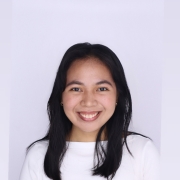
[Having my work published] feels incredible. Sometimes you don't realize what's possible until you take the chance. Then suddenly, the things you hoped for really do happen.
These findings contribute to a growing body of research on child language development and have practical implications for parents, educators, and clinicians. For example, Escario’s study built off work Arunachalam did previously on how toddlers acquire verb meanings.
“We can tell parents and SLPs [speech-language pathologists] to talk more or use certain toys,” says Escario. “But the way they construct their sentences matters, too. By better understanding what kinds of language structures children are most likely to learn from, we can better prepare the adults who work with them to achieve those goals.”
Escario practiced as an SLP in her home country of the Philippines before enrolling in NYU Steinhardt’s CSD program so she could become certified to practice in the United States. A native Tagalog speaker, Escario is particularly interested in expanding evidence-based practices beyond English.
“English speakers often think that English is an easy language, but it’s actually very complex,” says Escario. “Although our study focused on English, its broader goal was to strengthen the scientific foundation for understanding language learning across languages.”
“I’m so proud of the work Madelyn did on her thesis,” says Arunachalam. “I thought this would be a great project for her because, although we started out with English, Tagalog positions adjectives both before and after nouns, so there are potentially interesting follow-up research questions we could ask. It’s so important for our field to train researchers and clinicians who speak different languages.”
Since completing her master’s degree at Steinhardt, Escario has earned her professional certification and completed her clinical fellowship. She now works with patients across the lifespan, providing care to adults in a subacute rehabilitation setting while continuing to serve bilingual and multilingual children through a pediatric clinic.
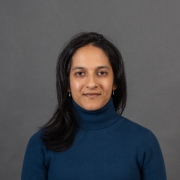
I’m so proud of the work Madelyn did on her thesis. . . . It’s so important for our field to train researchers and clinicians who speak different languages.
“I’m very thankful to Dr. Sudha and the LEARN Lab at NYU, and I’m grateful for everyone who helped and participated in this study,” says Escario. “We started this study from scratch and produced the material after two years. More linguistic research is needed, and I hope to see even more studies that promote culturally responsive practices.”
In the future, Escario herself hopes to conduct some of that additional culturally responsive language research that can have an impact beyond clinical practice to education and other fields. Seeing her work published is something she never imagined.
“It feels incredible,” says Escario. “Sometimes you don't realize what's possible until you take the chance. Then suddenly, the things you hoped for really do happen.”
Related Articles

Children Receiving Biofeedback Speech Therapy Improved Faster Than with Traditional Methods

Dean’s Alumni Advisory Board Member Julie Case (PhD ’19; MA ’07) Awarded Hofstra’s Researcher of the Year Award

NYU Steinhardt Co-Hosts Workshop on Trauma-Informed Care for Asian American Communities
Related Programs


Communicative Sciences and Disorders
665 Broadway, 9th floor
New York, NY 10012
Phone: 212-998-5230