
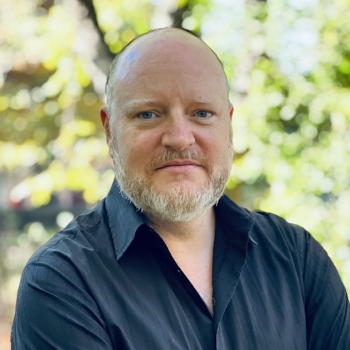
Sam Howard-Spink
Clinical Professor; Program Director of Music Business
About
Sam Howard-Spink, PhD is Clinical Professor and Program Director of Music Business at NYU Steinhardt's Department of Music and Performing Arts Professions. His teaching and research interests are in the political economies of international music industries and cultures, with a focus on national, regional and diasporic markets. Among the topics covered in Sam's courses at NYU are cultural and economic "glocalization", hybridization and cosmopolitanism; soft power governance, music diplomacy, national and supranational cultural and copyright policies, and Music Cities policy; music fandoms and fan engagement strategies; and social video, video games, virtual artists and other interactive media involving music.
Emerging Models and Markets for Music (EM3), the graduate course Sam designed and teaches at NYU, covers hybrid business models for music, and the markets of Brazil and Latin America; South East Asia including South Korea, Japan, and China; India and the Desi diaspora; and Pan-Africa including Nigeria, South Africa and MENA. In the undergraduate Music Business Program, Sam teaches International Music Business Marketplace, and formerly Interactive, Internet, and Mobile Music, surveying various digital and networked distribution and fandom models. In addition to EM3 — also offered as a January intensive course in Rio de Janeiro, Brazil — he teaches the graduate research class Environment of the Music Industry, and supervises Masters' student capstone Colloquy thesis projects. Sam joined the Music Business faculty in 2008, and was awarded the MPAP department's Teacher Of The Year in 2009. He was appointed Program Director in Fall 2025, and promoted to the rank of Clinical Full Professor in 2026.
A Londoner by birth, Sam was a music business journalist and editor in the UK and Hong Kong before moving to New York in 1999. He has a BS in Psychology from the University of Bristol in the UK; an MA in Communications from Hunter College CUNY; and a PhD in Media Ecology from NYU's Department of Media, Culture and Communication. His 2012 doctoral dissertation was a comparative study of industry and governmental responses to Internet music file-sharing/piracy in Brazil, Canada, and the United States, examined through the critical theoretical lenses of Cultural Hybridization, Network Information Economics, and Modern Social Imaginaries.
Sam's most recent publication is a 2024 Sage Business case study of the K-pop group BTS's role in contemporary South Korean soft power. He has presented papers on the value and utility of glocalization theory in higher-ed music business programs at conferences at USC in California (Association of Popular Music Education Conference, 2024) and Flagler College in Florida (Research in Popular Music Conference, 2023), and in 2025 gave a presentation about emerging music business models and markets for the U.S. Department of State's Bureau of Educational and Cultural Affairs.
Over the course of his career, Sam has written for, among others, Music Week, Music Business International, Music & Copyright, The Guerrilla Guide to the Music Industry, The South China Morning Post in Hong Kong, IBM Think Research and openDemocracy.net, and has published academic articles in First Monday and in Portuguese translation in Brazil. Research in 2018 included a funded study of changes to US recording industry indicators and metrics. He has spoken on panels or given talks at South By South West (SXSW), the Association of Popular Music Education, the Audio Engineering Society, the Brazilian Studies Association, SOAS in London, and numerous guest lectures. In 2009, Sam curated CMJ PLAY, a one-day conference on business opportunities for musicians in the interactive, mobile apps, and gaming sectors.
Sam is a samba drummer and segundo surdo section leader in Brazilian bateria Samba New York!, and performs with the group regularly. He is also a former hiphop/scratch DJ, and to this day remains an expert-level Guitar Hero on Xbox.
Publications
- "BTS and South Korean soft power." Sage Business Cases. SAGE Publications, Ltd. 2024. https://doi.org/10.4135/9781071941119
- “Grey Tuesday, online cultural activism and the mash-up of music and politics.” First Monday, Oct 2004.
- “Activism remixed: Downhill Battle’s role in the copyfight.” EastBound, Journal of the Centre for New Media Research, Budapest. 2005.
- “Brazil.” The International Recording Industries, Lee Marshall (Ed.). Routledge. 2013.
- “Brazilian blends: Tropicalia, WIPO and the emerging global mix of culture and politics.” (in Portuguese translation). Propriedade Intelectual, International Trade Law and Development Institute of the University of São Paulo Law School, Brazil, Sept 2007.
- Book Review of Hall, G. (2008). Digitize This Book! The Politics of New Media, or Why We Need Open Access Now. Minneapolis: University of Minnesota Press. In Journal of Communication Inquiry, Vol. 33, No. 4, 424-428 (2009).
