

How the Research Alliance Contributes to Better, More Equitable Public Schools
August 2026
At the Research Alliance for New York City Schools, our mission is to advance equity and excellence in education by providing rigorous, nonpartisan evidence about policies and practices that support students’ development and academic success. Since 2008, we have worked with NYC Public Schools, the City University of New York, educators, community organizations, and other local stakeholders to conduct research on issues that matter deeply to New York City’s education system.
In many of the programs and initiatives we study, we help partners articulate a theory of action: a clear explanation of the things they hope to accomplish, the strategies they will use to get there, and the assumptions that underlie their work. This process surfaces important questions about how various program elements are supposed to be implemented and the outcomes they are expected to achieve. Answering these questions helps leaders clarify priorities and strengthen communication about the program; it also creates a solid foundation for learning and improvement over time.
For many similar reasons, we believe research organizations should also have a clear theory of action or change. Drawing on our 18 years of experience; relevant studies of research-practice partnerships across the country and evidence use in multiple contexts; as well as conversations with staff, partners, stakeholders, and peer organizations, we have been working to clarify the Research Alliance’s theory of action. The diagram below outlines how we believe the Research Alliance contributes to higher-quality evidence, stronger use of evidence, and, ultimately, better and more equitable public schools.
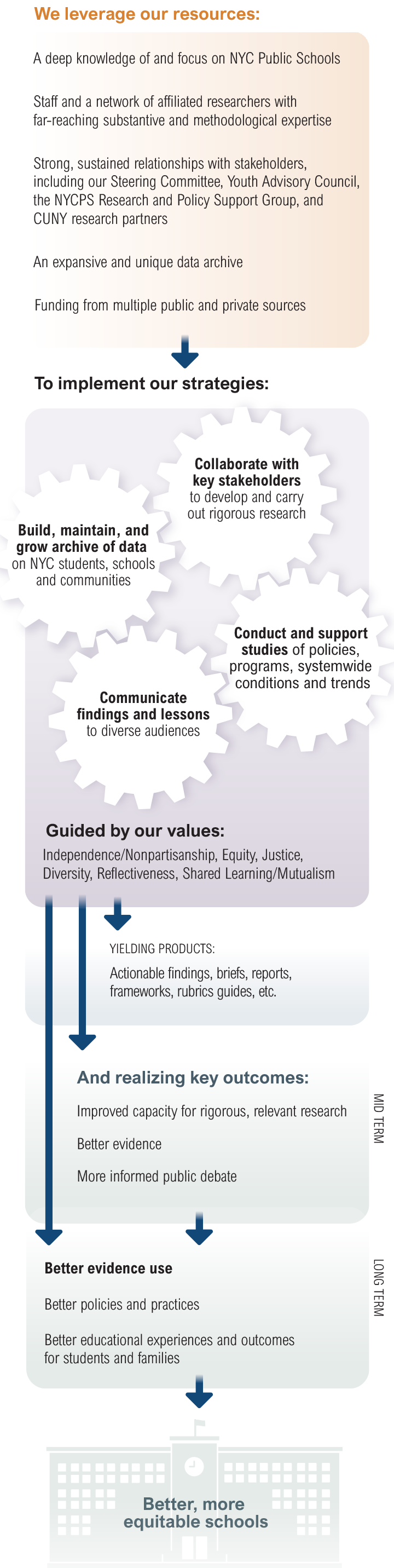
The theory of action describes our core values (in the central purple box, near the bottom) as well as the resources and capacities that make our work possible (in orange, on the far left). As shown in the “gears” in middle of the graphic, our day-to-day work is composed of four main strategies: building, maintaining, and growing the Research Alliance data archive; collaborating with stakeholders to develop and carry out research; conducting and supporting studies of policies, programs, initiatives, and system-wide conditions and trends; and communicating findings to a broad audience in clear, accessible ways. These strategies yield a variety of concrete products (findings, reports, frameworks, etc.) and lead to key mid-term outcomes (listed on the right). These include stronger capacity for rigorous and relevant research across NYC’s education system; better evidence (e.g., credible, timely, clear, applicable); and more evidence-informed public debate about education issues. The longer-term goal is better evidence use. By this, we mean education stakeholders applying high-quality evidence to help define problems, set priorities, identify promising solutions, improve implementation, understand impact, and expand approaches that work best.
Ultimately, as shown in the graphic, we expect that better evidence use will contribute to more effective education policies and practices, better educational experiences and outcomes for New York City students, and better, more equitable public schools.
You can read more about our Theory of Action here, including additional details about the elements outlined above. We also highlight a variety of contextual factors that matter for accomplishing our goals as well as some important tensions in our work.
A strong theory of action should help an organization reflect, learn, adjust, and improve. For the Research Alliance, our theory is already helping us think more carefully about where to invest our resources, which capacities to build, and how to assess our impact. Looking ahead, we will continue to test, refine, and strengthen this theory, and we will use what we learn to continuously improve our work on behalf of New York City’s students, schools, and communities.
Have questions or suggestions about the Research Alliance’s theory of action? Read the full breakdown, or contact us at research.alliance@nyu.edu.
Archive

Executive Director's Note: May 2025

Research Director's Note: September 2024

Executive Director's Note: February 2024

Executive Director's Note: November 2023

Executive Director's Note: September 2023
Executive Director's Note: August 2023

Executive Director's Note: July 2023
