

The mission of the Research Alliance for New York City Schools is to advance equity and excellence in education by providing nonpartisan evidence about policies and practices that promote students’ development and academic success. Since 2008, we have worked with a range of local stakeholders, including NYC Public Schools (NYCPS), the City University of New York, educators, and community groups, to conduct rigorous studies on topics that matter to NYC’s education system.
One of the things we often do with the programs and initiatives we study is to help them develop a theory of action, outlining the results they hope to accomplish—and how they expect to get there. As we wrote in Better Evidence for Better Schools, “...the Research Alliance encourages in-depth conversations about an initiative’s theory of action… We have often found that stakeholders have differing underlying ideas about the initiative’s work. There can be confusion or disagreement about the definition of terms, how program elements are supposed to be implemented, which activities and outcomes are most important and can be realistically achieved, and how outcomes should be measured…. We have seen conversations about the theory of action inform how initiative leaders define, prioritize and communicate about their work. Equally important, a clear theory of action provides a foundation for assessing and improving an initiative’s implementation (and impact).”
For similar reasons, we believe research organizations should also have a clear theory of action or change. Drawing on our experience over the last 18 years; relevant literature, including studies of research-practice partnerships across the country and evidence use in multiple contexts; as well as conversations with staff, partners, stakeholders, and peer organizations, we developed the following theory of action describing how the Research Alliance seeks to fulfill our mission:
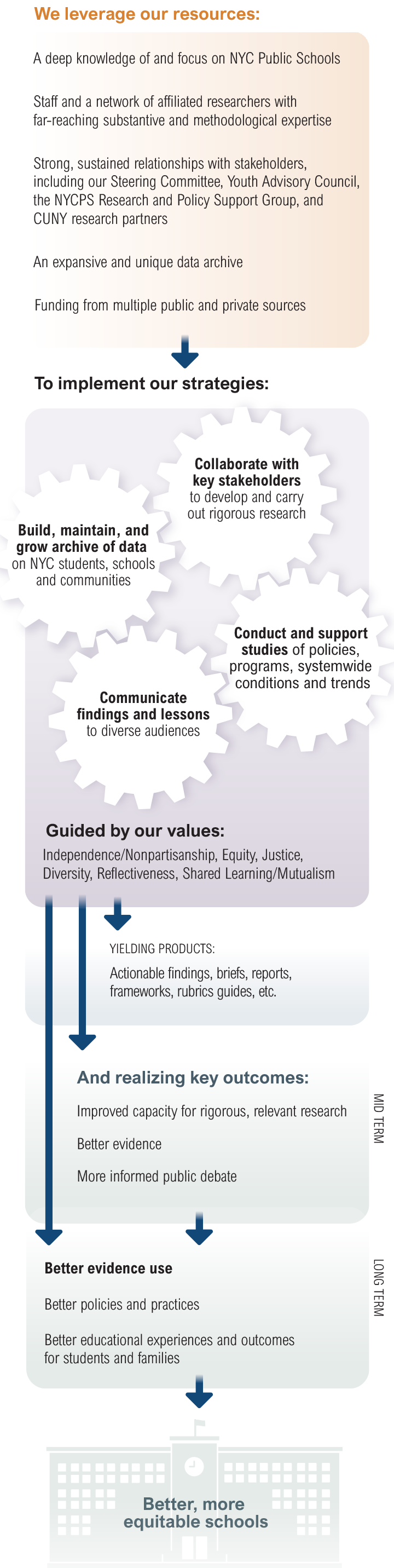
Theory of Action Summary
The Research Alliance’s Theory of Action illustrates how our resources, strategies, and values work together to produce actionable research and support better educational experiences and outcomes for New York City students and families.
We begin by leveraging several core resources: deep knowledge of and sustained focus on New York City Public Schools; staff and affiliated researchers with broad substantive and methodological expertise; strong relationships with stakeholders, including our Steering Committee, Youth Advisory Council, NYCPS Research and Policy Support Group, and CUNY research partners; an expansive and unique data archive; and funding from multiple public and private sources.
These resources support four primary strategies: collaborating with key stakeholders to develop and carry out rigorous research; building, maintaining, and expanding an archive of data on New York City students, schools, and communities; conducting and supporting studies of policies, programs, systemwide conditions, and trends; and communicating findings and lessons to diverse audiences.
Our work is guided by the values of independence and nonpartisanship, equity, justice, diversity, reflectiveness, and shared learning and mutualism.
Together, these efforts yield products such as actionable findings, briefs, reports, frameworks, rubrics, guides, and other research-informed resources.
Over the mid term, this work is intended to strengthen capacity for rigorous and relevant research, produce better evidence, foster more informed public debate, improve the use of evidence, and contribute to better policies and practices.
Over the long term, these outcomes are intended to support better and more equitable schools and improved educational experiences and outcomes for students and families.
The theory starts by outlining the resources, capacities and values that underpin our work. Our core values, shown in the central purple box, near the bottom, include independence and nonpartisanship, equity, justice, diversity, reflectiveness and shared learning/mutualism. Nonpartisanship and “advancing equity in education” are essential, explicit parts of the Research Alliance mission. Our commitments to equity and justice are grounded in an understanding of the history of New York City’s education system, broader social and economic conditions, and the persistence of disparities associated with race, ethnicity, poverty, gender, language, immigration status, and disability. We prioritize diverse perspectives on our staff and among our partners and research participants because we know that individual backgrounds shape our experiences, biases, assumptions, and interpretations. Bringing people with varied perspectives together—in the spirit of openness and self-reflection, shared learning, mutual benefit and mutual respect—is central to our work.
The key resources and capacities that make this work possible are presented in orange, on the left side of the graphic. Among the most important are our focus on New York City Public Schools and the relationships we nurture with local education stakeholders, defined as anyone who sets, implements, influences, or is impacted by education policies in NYC. These relationships range from informal advisory roles (with us sometimes offering advice, and other times benefitting from it) to sustained, in-depth, multi-project partnerships, and formal bodies that provide ongoing, regular guidance about the Research Alliance’s work. Our team collaborates with the NYCPS Research and Policy Support Group, various other divisions and offices within NYCPS, and an array of nonprofits that work in and around the City’s education system. We augment our internal research capacity with a network of external affiliates, at NYU and other universities around the country, who bring an impressive breadth of knowledge and experience. We have a Steering Committee composed of leaders from key stakeholder groups, including NYCPS, CUNY, the teacher and administrator unions, charter schools, community-based organizations, and businesses, as well as a formal Youth Advisory Council that provides input on our research agenda, findings, and communication strategies. Our researchers engage parents and educators as advisors on specific projects, and we are eager to deepen their involvement in future studies.
The Research Alliance’s data archive is another critical resource. It is among the largest and most comprehensive education databases in the country, including decades of administrative, human resources, and School Survey data from NYCPS (thanks to a formal data-sharing agreement), as well as information from other agencies, such as the U.S. Census Bureau and the National Student Clearinghouse. Recent shifts in federal policy and the disappearance of public data sources have underscored the importance of data infrastructure, transparency, and accountability. We rely on and celebrate the willingness of cities like New York to make data available to researchers and the general public.
The Research Alliance’s work is supported by funding from diverse public and private sources, which helps safeguard our independence and nonpartisanship (meaning our research is never tied to any particular political party, policy agenda, or ideology). Our independence—along with the substantive and methodological expertise of our staff and affiliates—allows us to produce evidence that is valid, reliable, useful, and credible to diverse audiences, in NYC and beyond.
We leverage all of these resources and capacities in pursuit of our mission. The bulk of our day-to-day work, the “strategies” represented as interlocking gears in the middle of the graphic, falls into four main categories:
- Building, maintaining and continuing to expand the Research Alliance data archive: We invest considerable time and energy to curate and securely maintain the information that we receive from external partners. This includes managing regular data updates and developing needed documentation and guidance, linking data from different sources, and transforming data into researcher-friendly formats, safely stripped of identifying details and suitable for analyses (safeguarding teacher and student privacy is a central priority and a responsibility we take extremely seriously). We also cultivate new data-sharing partnerships with the goal of illuminating a wider range of student contexts, experiences, and outcomes.
- Collaborating with key stakeholders to develop and carry out research: The Research Alliance engages stakeholders in all phases of our work—from setting priorities, to developing studies, to interpreting results. We have created a variety of mechanisms to support collaborations of different kinds, with educators, students, parents, district leaders, nonprofit partners, and members of our Steering Committee. We are committed to the notion that lived experience is expertise, and we strive to elevate voices that are often missing in education research and policy conversations. We see all of these efforts as crucial to ensure that our research addresses pressing issues in the system and generates valuable information that stakeholders will actually use.
- Conducting and supporting rigorous studies: This includes studies examining the implementation and impact of specific policies, programs and initiatives, as well as analyses of system-wide conditions and trends. We also support rigorous research conducted by other individuals and institutions (for example, by “match making” between researchers and practitioners, or providing access to data).
- Communicating findings and lessons from our work: Findings that are presented in confusing, jargon-y terms, or published only in long, overly technical research reports and academic journal articles are unlikely to have an effect on education policy and practice. We strive to develop clear, compelling messages about our research, and we leverage various platforms and tactics to share insights from our work with education decision makers and the general public.
This ongoing, collaborative, iterative work has concrete, short-term outputs, shown in the upper right corner of the graphic. These include reports, briefs, spotlight posts, slideshows, frameworks, rubrics, guides, assessments, surveys, and other usable applications of our findings. Over time, our strategies also lead to important mid-term outcomes, summarized in the first green box, namely:
- Improved capacity for rigorous, relevant research throughout NYC’s education system (e.g., stronger relationships between researchers and stakeholders; improved skills and knowledge enabling us to conduct more useful studies; and improved ability, within the district, to participate in, absorb, and act on research);
- Better evidence (that is, findings that are rigorous, credible, relevant to stakeholders’ needs and clearly communicated); and
- More evidence-informed public debate (this is important because visibility and awareness of evidence can help move public opinion and drive changes in policy and practice, as we have seen in recent years with the spread of “the science of reading” across the country).
Our theory posits that these mid-term outcomes will help us to realize a key long-term outcome of interest—better evidence use. This involves local stakeholders employing high-quality evidence to:
- Set priorities and create frameworks that guide thinking and action;
- Define and understand systemic challenges and particular problems of practice;
- Identify and consider potential solutions to these problems;
- Assess and improve the implementation of policies, initiatives, and practices;
- Understand the impact of specific policies, initiatives, and practices;
- Change or discontinue ineffective strategies; and
- Replicate or expand effective strategies.
Ultimately, we expect that these actions will lead to more effective education policies and practices in New York City. This, in turn, will foster better educational experiences and outcomes for students and better, more equitable public schools, as shown in the green in the lower right corner of the graphic. There are, of course, a variety of contextual factors that influence our ability to achieve these goals. The context in which we work presents both opportunities and challenges: For example, the size and diversity of NYC’s education system means we can conduct research that simply wouldn’t be possible elsewhere, but it also makes change at scale unusually difficult. Likewise, economic conditions, state and federal policies, and local political realities all shape what we can accomplish in any given moment.
Mapping out the expectations and assumptions that underlie our work highlights a number of important questions—including parts of our theory that are vulnerable: How should we manage tensions between close collaboration with partners and the independence that helps make our work broadly credible? Is it possible to produce research that is both scientifically rigorous (which often takes time) and relevant to stakeholders’ immediate needs and interests? How does turnover, at the Research Alliance, and at the school and district level, affect the collaborations at the heart of our work? What factors impede stakeholders’ ability to engage with and use research? What considerations—besides evidence—shape key policy and practice decisions? And, in light of the many external mediators that influence school quality and student success, how can we maximize our contributions toward improving the experiences and outcomes of the City’s youth?
The theory we have developed is helping us grapple with these fundamental questions and make smarter decisions about how we work (e.g., skills and capacities we need to build, and how best to invest limited time, energy and financial resources). The theory is also helping us evaluate the extent to which we are actually making a difference for NYC’s education system. For instance, we undertake regular check-ins with partners and have fielded stakeholder surveys to gather information about how we are doing along various dimensions of the theory of action, and we are pursuing opportunities to rigorously test specific strategies to enhance decision makers' use of evidence.
Looking ahead, we will take what we learn and feed it back into our theory, making adjustments as needed. This will enable us to continuously reflect on and strengthen our work on behalf of NYC students, schools and communities.
Have questions or suggestions on the Research Alliance theory of action? Contact us at research.alliance@nyu.edu.